

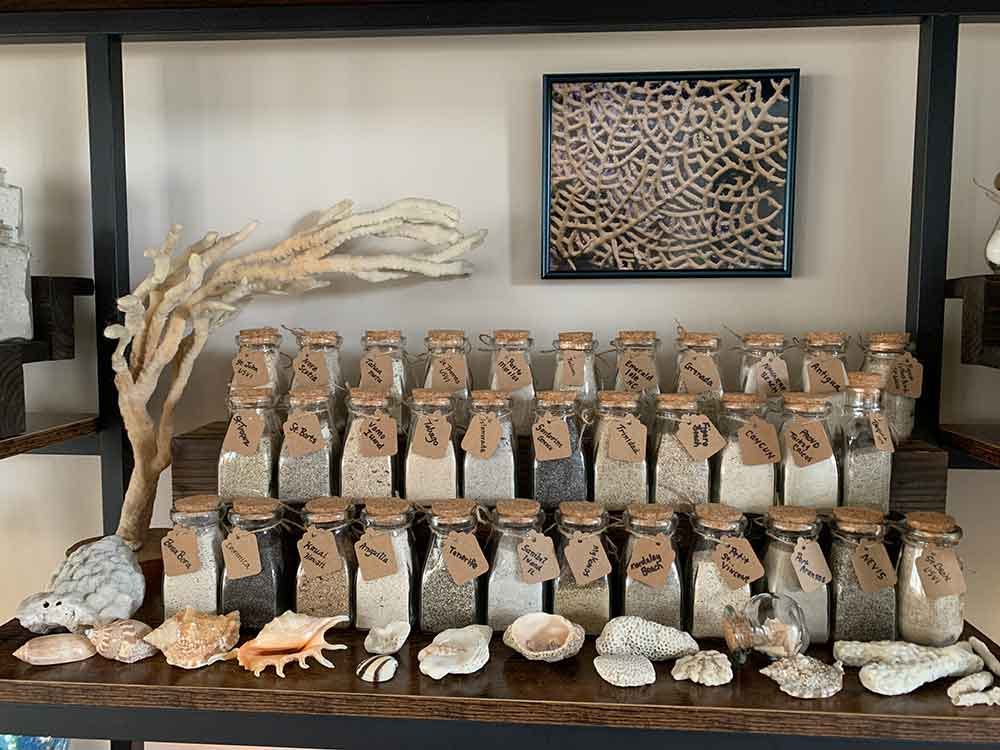
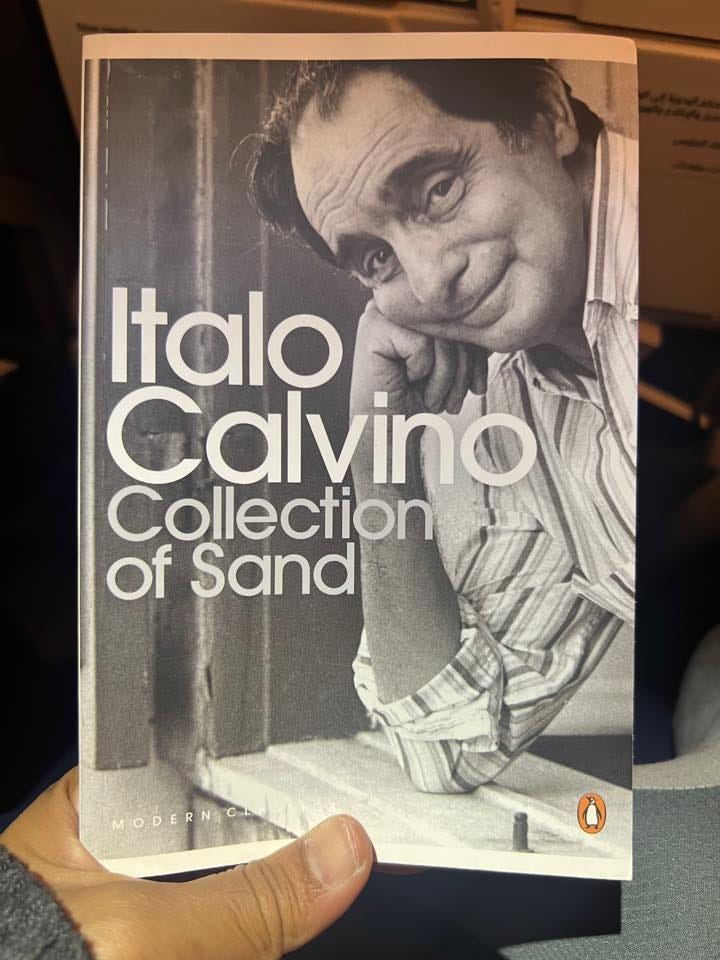
Italo Calvino’s essay collection starts with this short sentence: “There is a person who collects sand.”
That brief sentence, all of six words, made me pause and think for a moment. About sand, and about such a person. About their interest in collecting sand. Of all that is collectible, why would they choose to collect sand? It’s a curious enterprise. This person travels the world, but wherever they go, they go in search of a beach, a river, or a lake bed to find a wee bit of sand. What drives them to do that?
Calvino uses this sandy opening to launch into the first section of the book, which focuses on his visits to eccentric exhibitions in Paris. He wanders through collections of cowbells, gas masks, terracotta whistles, bottle tops, toilet paper packaging, and so forth. He then asks a question about the nature of collecting:
The fascination of a collection lies just as much in what it reveals as in what it conceals of the secret urge that led to its creation.
Ah! And is there an inherent politics to it?
In some sense, a collection is also like a diary, each item in the collection being a diary entry: “[…] a diary of travels, of course, but also of feelings, states of mind, moods […]”
He ends the essay with a touching note reflecting on his own work of decades—that of collecting and putting together words. What has been the purpose of it all?
“So, deciphering the diary of the melancholic (or happy?) collector, I have finally come round to asking myself what is expressed in that sand of written words which I have strung together throughout my life, that sand that now seems to me to be so far away from the beaches and deserts of living. Perhaps by staring at the sand as sand, words as words, we can come close to understanding how and to what extent the world that has been ground down and eroded can still find in sand a foundation and model.”
The Observer
The first part of this collection (which shares the title “Collection of Sand”) focuses on reflections based on visits to different exhibitions in Paris. The second deals with a variety of visual aspects of observation; the third with the fantastical and the imaginary. The fourth part contains reflections from his travels in three countries: Japan, Mexico, and Iran.
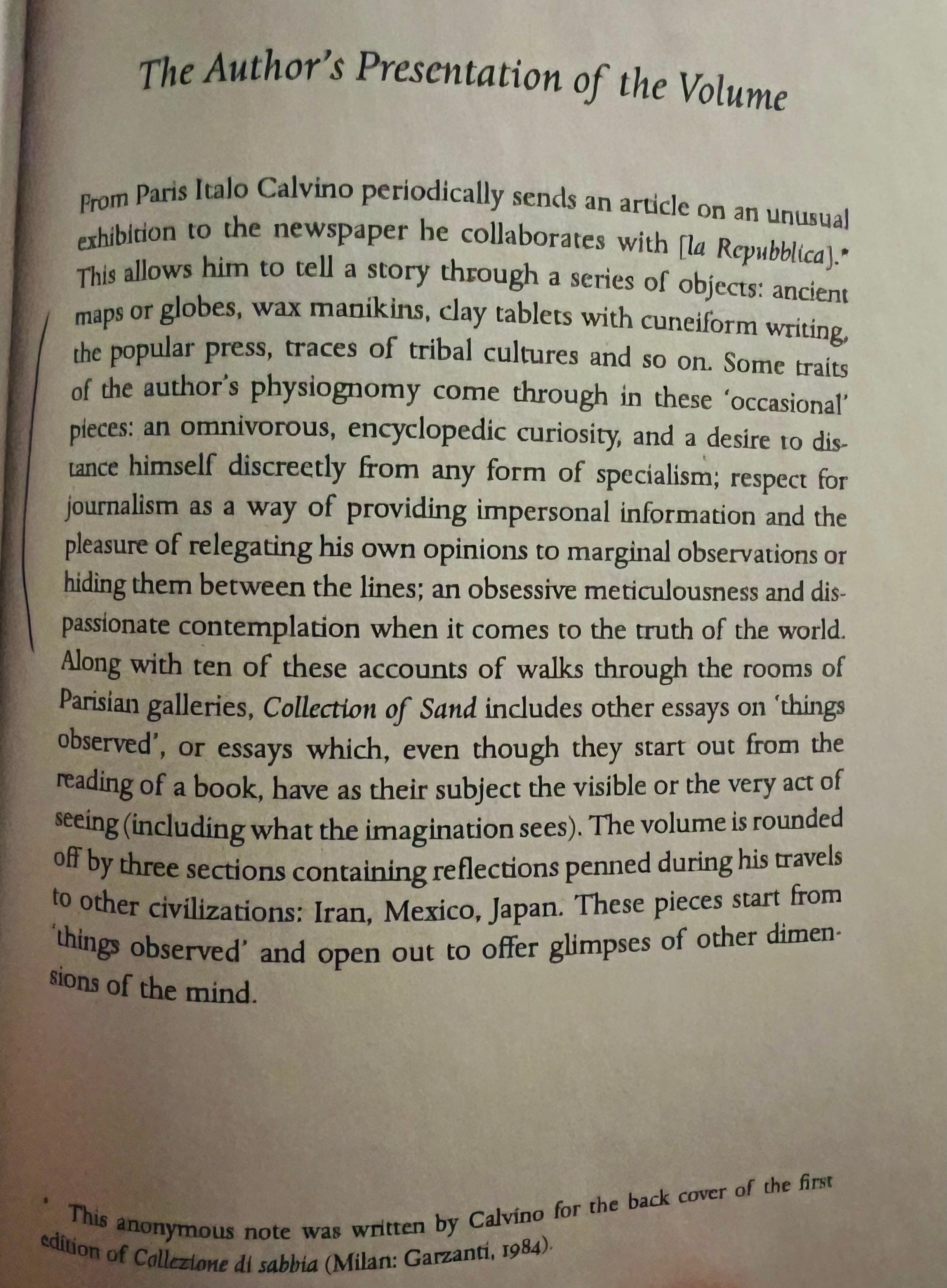
This is what Calvino himself had to say about his work, in an “anonymous” note he penned for the back cover of the first edition:
“From Paris Italo Calvino periodically sends an article on an unusual exhibition to the newspaper he collaborates with... This allows him to tell a story through a series of objects: ancient maps or globes, wax manikins, clay tablets with cuneiform writing, the popular press, traces of tribal cultures and so on.
Some traits of the author’s physiognomy come through in these ‘occasional’ pieces: an omnivorous, encyclopedic curiosity, and a desire to distance himself discreetly from any form of specialism... These pieces start from ‘things observed’ and open out to offer glimpses of other dimensions of the mind.”
All in all, the writings here are about “things observed” by an inexhaustibly curious onlooker.
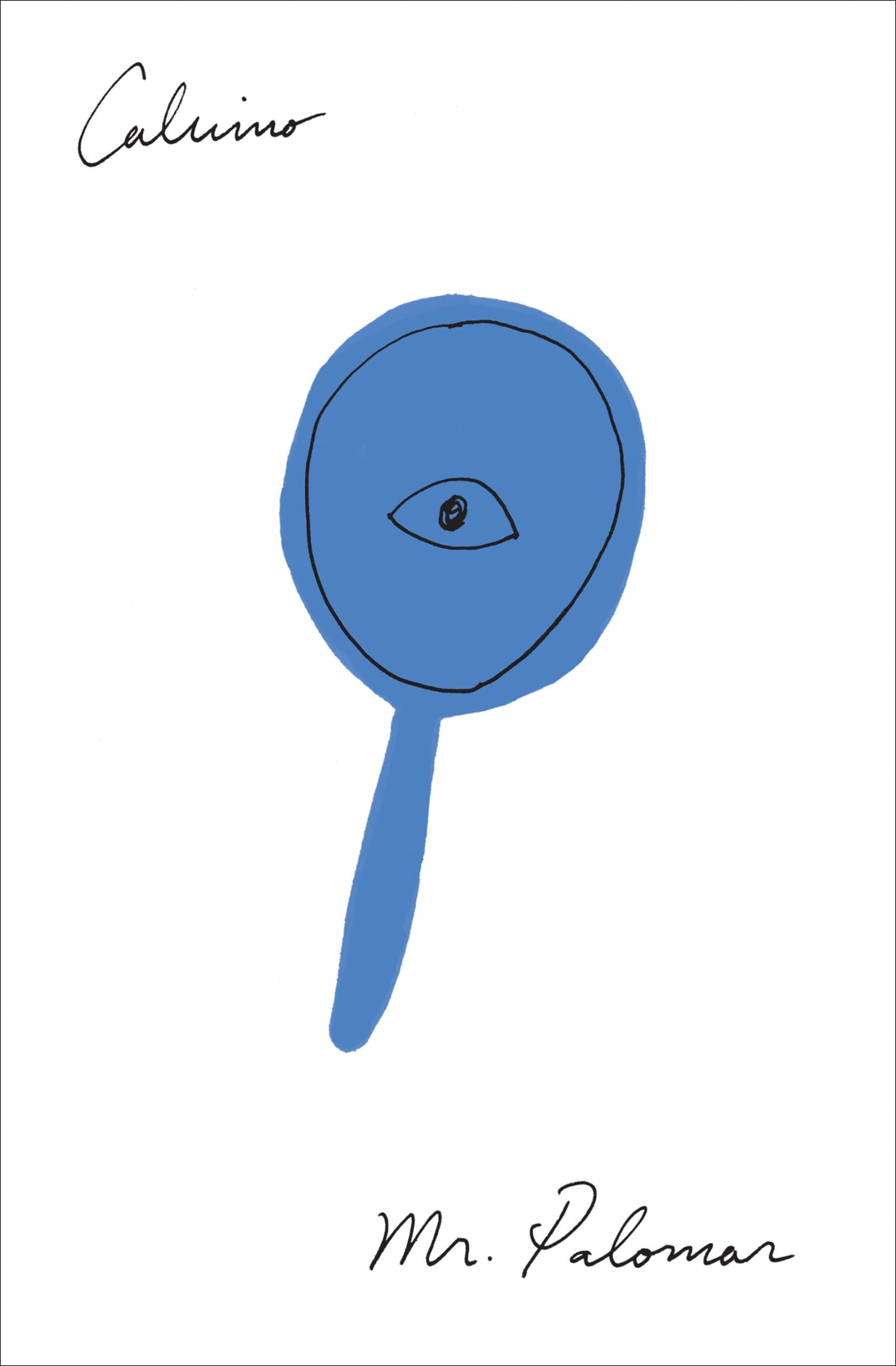
In 1983, Calvino wrote Mr. Palomar, consisting of 27 fictional sketches or vignettes in which Mr. Palomar meditates deeply on questions of the cosmos, existence, and culture. He makes observations in search of meaning in things. Mr. Palomar does nothing but observe and live an intellectual life essentially in his head. In this collection, we see that Calvino is Mr. Palomar.
Knotty Communications
The book moves from collections to the visual aspects of observation, and here Calvino’s obsession with signs—semiotics—takes center stage. He writes beautifully about the symbolism behind knots, for instance.
“In New Caledonia messages of war and peace were transmitted by means of a rudimentary rope made from banyan bark knotted in various ways. […] A knot around a small firebrand - extinguished, but with traces of burning on it - was a declaration of war... […] The art of making knots, which is the peak of both mental abstraction and manual work, could be seen as the human characteristic par excellence, just as much and perhaps even more than language...”
Knotty communications? Or perhaps the rich language of knots.
The Emergence of Writing
He also writes about the other—perhaps the most important—form of semiotics: writing. This arrested my attention given my own interest in the topic. In an essay called “Before the Alphabet,” Calvino traces the emergence of writing to Lower Mesopotamia (Uruk, c. 3300 BC), the land of clay. He notes how the the material dictated the form: because curves didn’t hold well in clay, pictograms became stylized, triangular, and cuneiform.
“Writing first emerges in Lower Mesopotamia... This was the country of clay: administrative documents, bills of sale, religious texts or those glorifying kings were engraved with the triangular point of a reed or quill on clay tablets which were then dried in the sun or baked. […]
In general these signs had a triangular apex that then prolonged itself into a line forming a kind of nail shape, or forking into two lines like a wedge: this was cuneiform writing... writing that transmitted an impression of rapidity, movement, elegance and compositional regularity.”
He reasons about why this might have happened in Mesopotamia. Writing, unlike speech, is not natural. Most of the languages humans have spoken do not have writing systems. Perhaps it is external social, political, or cultural pressures that are responsible for writing being invented. For instance, in Lower Mesopotamia, the development of irrigation and agriculture resulted in a demographic explosion leading to a complex social hierarchy. Writing here began as a receipt; it was a technology born of the boring necessity of accounting.
As I read these passages, I started thinking about the emergence of writing. How did it emerge in Mesopotamia and not somewhere else? There were many intellectually advanced civilizations in the ancient world: the Greeks, the Harappans, and so forth. Why was there no writing among the Aryans despite the huge intellectual achievement of the Vedas? Perhaps their focus was not on the permanent record of clay, but on the eternal sound of Śruti—that which is heard and preserved through precise oral recitation.
And in general, why did certain technologies in the ancient world develop at certain specific places and not others? Sometimes even the spreading of those took time. The Greeks perhaps took up writing very soon and evolved their own system. Probably not others. I wondered how technology can be a function of the terrain, vegetation, and other geographical or ecological factors.
Also, weren’t societies like the Harappans fairly complex and well-organized, with a lot of long-distance trade relations? While the Harappan “script” is yet to be deciphered, there are arguments (like the controversial “Farmer-Sproat-Witzel” hypothesis) that suggest it might not even be a script. If those pictograms are merely isolated concepts—devoid of the grammatical glue of verbs and connectors—then they may not be a language at all. Even statistical analysis fails us here; unlike the trilingual Rosetta Stone that unlocked Egyptian hieroglyphs, we have found no such parallel corpus to crack the code of the Indus.
Why does certain technologies take root in certain terrains and not others? Calvino doesn’t answer this for us, but he provides the framework to ask the question: How much of our “intellectual” history is actually a history of our geography?
The Cost of Beauty
In the final sections, Calvino travels to Japan, Mexico, and Iran. In Japan, he is entranced by the gardens of Kyoto. He observes that everything seems spontaneous only because everything has been calculated.
“[…] There is one thing I seem to be starting to understand here in Kyoto... The construction of a nature that can be mastered by the mind so that the mind can in turn receive a sense of rhythm and proportion from nature...”
But Calvino refuses to let us simply admire the view, because there is a dark side to it, as there is always to what we call “high culture”. It is often built on top of the sacrifices of the poor and the downtrodden for the sake of the rich. There is an unseen or forgotten violence behind it. One of his students asks him, “Do you like all this? I cannot help thinking that this perfection and harmony cost so much misery to millions of people over the centuries.”
“But isn’t the cost of culture always this?” Calvino objects.
“Creating a space and time for reflection and imagination and study presupposes an accumulation of wealth, and behind every accumulation of wealth there are obscure lives subject to labour and sacrifices and oppression without any hope...”
This struck a chord with me. Whenever I visit historical monuments—be it the intricate carvings of Belur and Halebidu, the soaring heights of the Qutb Minar, or the marble perfection of the Taj Mahal—my admiration is always shadowed by this very thought. I wonder about the sacrifice of the countless lives that propped up these stones, spanning multiple generations. How many were struck down by the harsh sun? How many fell to their deaths from makeshift scaffolding? How many were crushed beneath the accidental slip of a massive slab?
I remember the first time this thought stopped me in my tracks. It was at the Kailasa temple in Ellora, carved out of a single rock face. Standing before that monolithic achievement, the sheer scale of the human toll felt heavy in the air. Since then, it is a thought that recurs wherever I go.
The essay ends with this haunting image:
“The group has reached a bed of smoothed, round stones... ‘These stones,’ the guide was explaining, ‘were brought here three centuries ago from every part of Japan. The Emperor rewarded whoever brought him a bag of stones with a bag of rice.’
The student shakes his head and looks bitter. We seem to see the queue of peasants conjured up by those words bent double under their bags of stones... Meanwhile the attendants busy themselves round the scales: on one dish there are the stones, on the other rice…”
Imagine the human cost of a bag of rice!
The Sword and the Leaves
Despite the weight of history, Calvino remains a master of lightness. In the essay “The Sword and the Leaves,” he recounts a Zen story that perfectly encapsulates his worldview.
“[…] the perfect Samurai must never concentrate his attention on his enemy’s blade, nor on his own, nor on striking his opponent, nor on defending himself, but must only annihilate his own ego; that it is not with the sword but with the non-sword that victory is won...
[…] Looking at the yellow leaves falling into the water, I remember a Zen story which only now do I think I understand.
The pupil of a great sword-maker claimed to have outdone his master. To prove how sharp his sword-blades were he immersed a sword in a stream. The dead leaves carried down by the current were neatly sliced in two as they went across the blade’s edge. The master plunged into the stream a sword that he had fashioned. The leaves flowed on, slipping right past the blade.”
Collection of Sand is a delightful, dizzying anthology. The best thing about Calvino is that he never truly stays on topic; he meanders. And it is in those meanderings—between the sand, the knots, the swords, and the leaves—that we find the joy of reading.