

Sometimes, the books that stay with us longest are not the ones we sought out, but the ones that found us during a moment of curiosity. A few years ago, while briefly researching the landscape of Central European literature, for an informal literary discussion I was asked to drive, I came across the work of Hungarian writer Magda Szabó. I was struck then, as I am now, by how she could take a canvas as small as a single neighbourhood and turn it into a profound exploration of the human soul.
I had written about it shortly after my first encounter with her masterpiece, The Door. Revisiting it today, I find that the questions it raised about trust, agency, and the “burden” of friendship feel more relevant than ever. It remains a story that haunts the periphery of my thoughts—a secret I feel compelled to share once again, with some minor editorial refinements.
There are novels with vast canvases, ambitious in scope and set against the backdrop of seismic historical events. There are others that are wildly imaginative, challenging our very conceptions of reality. But then there are those that affect us not through grand scale, but through the methodical sculpting of character. They shine a light—or rather, cause it to disperse—upon the commonplace, allowing us to see the world in numerous new, manifest colours. Magda Szabó’s 1987 novel, The Door (translated with precision by Len Rix), belongs firmly to this latter category.

The canvas here is decidedly intimate. Set in a quiet neighbourhood on the outskirts of Budapest, it chronicles the tectonic shifts in the relationship between two women: the narrator, a fictionalized version of Szabó herself, and her domestic help, Emerence. A third, silent witness to their lives is a dog named Viola; inadvertently, the animal’s fate becomes inextricably entangled with those of the two women.
From its brief, absorbing first chapter, the reader is drawn into a world that feels immediately intriguing, dark, and mysterious. With a pithy, peculiar laying out of the plot—one that hides far more than it reveals—one finds themselves in the midst of the story before they realize it has begun. What follows is essentially a confession: a narrative of betrayal. Well-intentioned, perhaps, but a betrayal nonetheless. The narrator, deeply religious and burdened by conscience, feels she must confess.
We meet the narrator at a professional crossroads. A writer living with her husband (also an author), her career is on the verge of a revival after a decade-long “political freeze”—a mirror to the real-world banning of Szabó’s books in Hungary. They require domestic help to reclaim their creative lives, and a friend recommends an older woman named Emerence.
Emerence, however, is not looking for a master. She possesses impeccable professional qualities, yet she is neither easily amused nor easily pleased. In a sharp reversal of power, it is Emerence who interviews and evaluates her potential employers. “I don’t wash just anyone’s dirty laundry,” she declares during their first meeting—notably held in her home. Eventually, she decides to take them in.
Emerence is a force of nature: old, strong-willed, fiercely private, and caustic beyond belief. She is the neighbourhood’s silent pivot, helping everyone and knowing everything, from local gossip to national shifts. Yet, she remains an enigma. The door to her house is barred; no one—not even her closest kin—is permitted to cross the threshold.
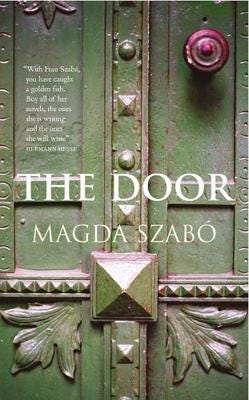
Over the course of twenty years, the relationship between the writer and Emerence evolves into a rollercoaster of mutual spite, long-held grudges, and closely guarded secrets. Yet, as trust is slowly bricked into place, they become as close as mother and daughter—an intimacy that is almost painful in its intensity. Their lives become intertwined in that way where love and hurt are no longer separable.
Szabó’s mastery of the novel form is most evident in how she simultaneously constructs and unravels her protagonist. As the pieces of Emerence’s past fall into place, the “door” begins to open in more than one sense. When the narrator finally learns what lies on the other side, the gesture of trust becomes a profound burden—a test of loyalty that eventually cracks under the strain.
The novel poses questions with no satisfactory answers. What is the “right” thing to do when faced with a moral dilemma? Is friendship an act of unwavering loyalty regardless of consequence, or does it take a looser, more convenient, conscientious form? To what extent should we be allowed the agency to lead our lives—and face our ends—in our own chosen manner?

I discovered Magda Szabó only recently while researching Central European literature. Born in 1917, she was a versatile talent—a novelist, poet, and dramatist—and is now recognized as one of Hungary’s foremost and most translated writers. Having lived through the tumultuous shifts of the 20th century, her work often reflects the intricate layers of human relationships and the weight of historical memory. While much of her extensive bibliography remains untranslated into English, The Door serves as a staggering introduction to her mastery. This is due in no small part to the work of Len Rix, whose award-winning translation captures the rhythmic precision and unsettling atmosphere of Szabó’s original prose. Rix’s ability to render the caustic, enigmatic voice of Emerence ensures that the power of this story remains undiluted for readers who read the work in English.