

It’s quite fulfilling to read Kafka’s short pieces of works — the shorter stories, parables etc. Of course, some of his short stories such The Judgement, The Metamorphosis, In the Penal Colony, and a bunch of others, and his novels are brilliant, but they’ve also been analyzed and interpreted ad nauseam. People have drawn parallels between his life, relationships, personal struggles, and his works endlessly.
However, if one really wants to understand Kafka the person, one should look at his short pieces. It’s these small fragmented thoughts — tiny pieces of wisdom — unfiltered lines resembling diary entries — outlines of half formed ideas — that often reveal a lot more about a person than a polished long form piece. In Kafka, you can see this mind that is constantly thinking, constantly observing, being sensitive to everything. We often talk about Kafka as being this dark and gloomy person. We talk incessantly of his anxiety and alienation. But in reality he was full of life. (At least, that’s the impression I get.) Any thoughtful person has dark and gloomy thoughts. We all feel anxious. We’re all alienated in some sense. Most people cope with it as a matter of course. The more sensitive and creative ones try to find an expression for it. Some choose to express them with colours, some with abstract poetry, realistic prose, some with fantasy, some with imagery, and so forth. The genius of Kafka found his own unique language and grammar to express the absurdity of life that a lot of people acutely perceive.
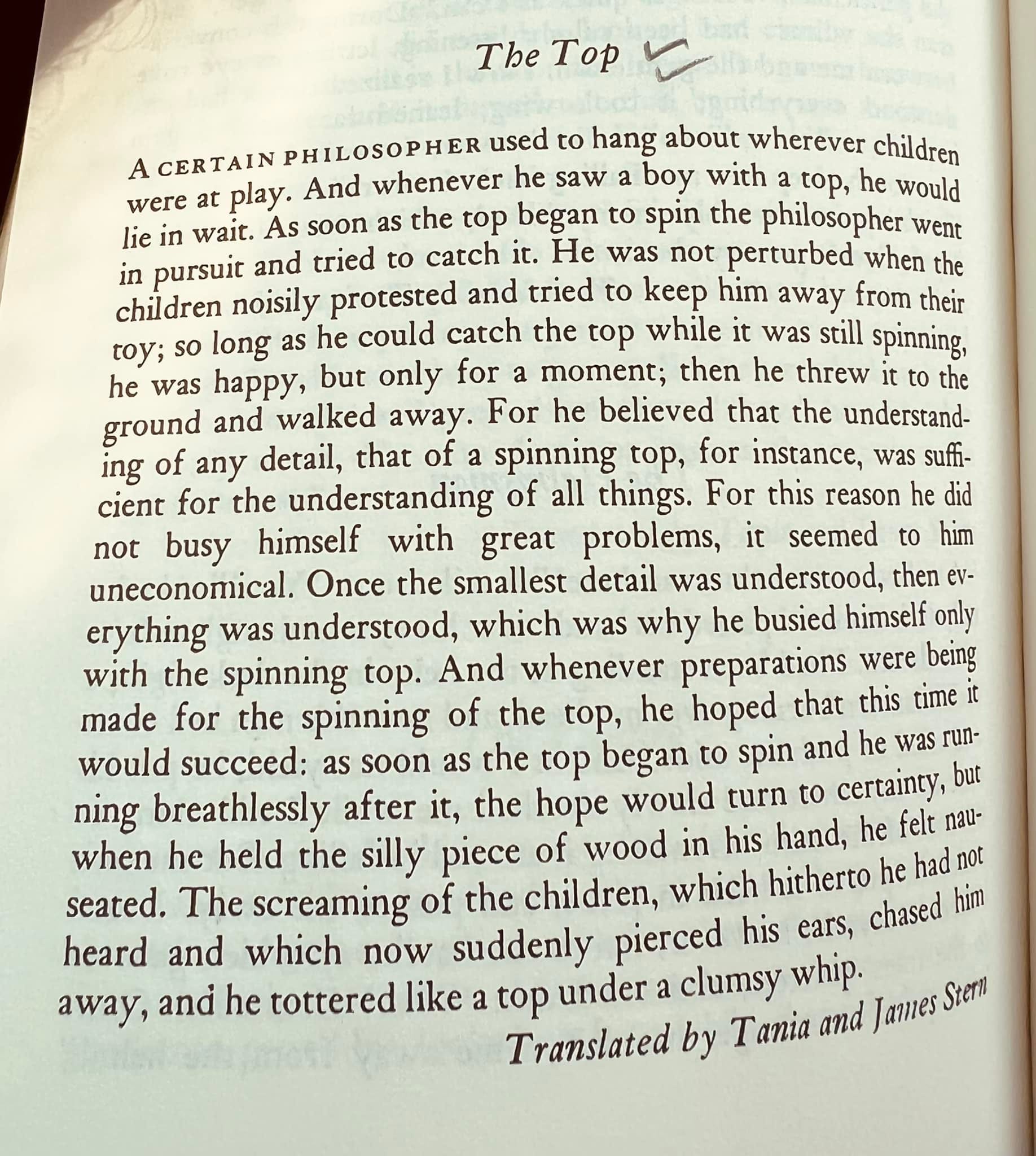
When you read his shorter pieces, you see his day to day struggles — just like ours — to fit in, to find a place. But he’s not given up. He’s not morose. He’s trying to figure it out. He’s this philosopher who hangs out with clamorous children curious to understand just the smallest detail. He totters like all of us as if under the influence of a clumsy whip. And yet he goes on out whenever he sees a boy with a spinning top.
That’s a celebration of life according to me. Kafka was full of joy and humour. There’s a lot more to the term “kafkaesque” than what’s purported.
Thanks for reading Dilettante Diaries! Subscribe for free to receive new posts and support my work.