

The first thing that strikes a reader about Mother Mary Comes to Me is the book’s stunning cover—the photographs on the jacket, the deep piercing red of the hardbound edition, and the overall care taken in its production. It’s clear from the start that everyone involved -- author, publisher, reader -- knows this book is destined to sell; it quietly announces itself as a bestseller. (Or perhaps it screams that!)
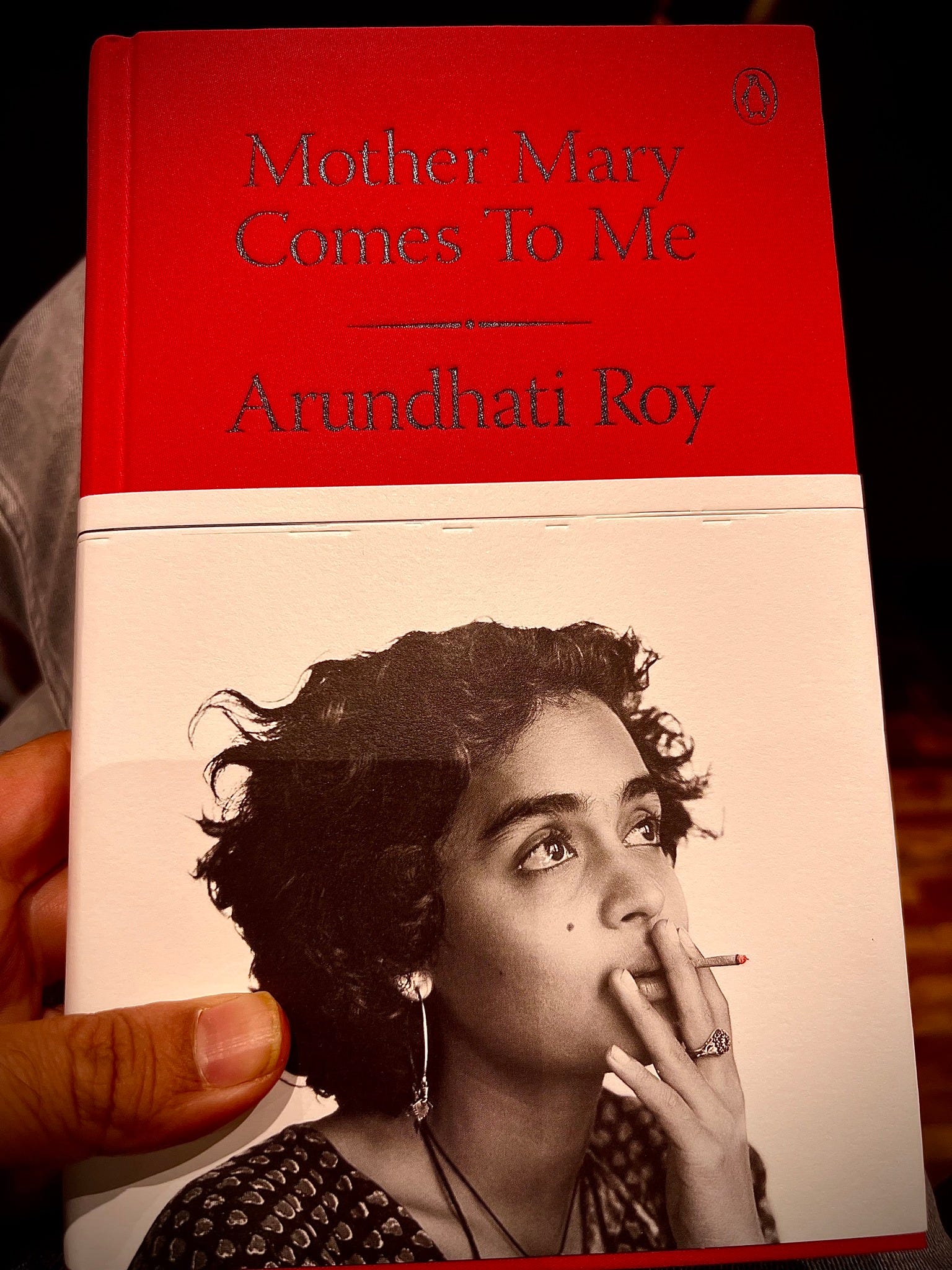
This is Arundhati Roy’s most intimate memoir, written in the wake of her mother’s passing. Mary Roy—an eminent educationist and a forceful advocate for women’s rights—emerges as a woman of extremes. She is a complex and forceful presence throughout. As you turn the pages, it’s hard not to be struck by her many contradictions: you see her as a mad genius: sharply intelligent, determined, and enterprising, yet also capable of astonishing cruelty. She could be painstakingly meticulous yet impulsive, generous to a fault to strangers but cruel to her own children. To the young students of her school, she was a nurturing figure, Mother Mary herself; to her own family, she could be almost the opposite. It sometimes feels as though, in order for her life’s mission to succeed, her children had to carry the burden of her failures and follies.
One of the recurring realities of this memoir is Mary Roy’s severe asthma. It wasn’t just a background illness—it was tied up with the emotional climate at home. If she became angry with her children, or felt they had crossed a line, her asthma could flare up. This naturally left her children anxious and careful, always alert and suppressing themselves to avoid triggering an attack. It is as if her asthma not only suffocated her, but also stifled them, holding everyone in its grip.
For readers who know The God of Small Things, the echoes here are unmistakable. Familiar characters, narrative loops, and thematic arcs resurface and overlap, demonstrating how Roy’s fiction is intricately entwined with her lived experience.
Roy also charts her own course: a journey from remote Assam, to Ooty and Ayenmenem, and finally running away from home to Delhi, where she gradually comes into her own. Along the way are the struggles of leaving home, life as a lone woman in a big city, and the financial challenges she faces—and, just as importantly, the privileges: a strong education (thanks to Mrs. Roy!), a network of talented friends, and a certain kind of access that helped her along.
While Mary Roy is the heart of the memoir, the book ultimately traces Arundhati Roy’s own path: her childhood in Assam and Ooty, her coming-of-age in Ayenmenem and Delhi, and her later forays into architecture, film writing, and acting—right up to the breakthrough moment with The God of Small Things. And what a breakthrough that proved to be!
Woven through it all are candid glimpses of Roy’s activist life—her critiques of popular culture, her engagement with various movements, and her willingness to stand apart even at personal cost. The memoir goes beyond broad references and recounts concrete moments—she calls out the filmmaker Shekhar Kapur (director of Bandit Queen, though never named directly in the book) with her critique, “The Great Indian Rape Trick.” She narrates her journey as a co-traveller in the Naxalite movement and her involvement with the Narmada Bachao Andolan, giving spirited accounts of participating in struggles around land, justice, and rights. These stories, vivid and specific, show her fighting spirit and willingness to confront power and take unpopular public stands.
As a reading experience, it’s brisk and engaging. Roy’s prose, as always, is exquisite; and the emotions come across as raw and honest. Yet, for all its elegance, the memoir sometimes feels a shade less intense than expected; for all its honesty, there remains something just out of reach, leaving an aftertaste of underwhelm that is difficult to name.