

How do I decide which book to read next? There has never been a single method. Sometimes it is a recommendation that lingers; other times, a sharp review catches my eye, or an author I admire mentions a work that influenced them. Curiously, I have never picked up a book simply because it won an award. I cannot quite recollect why I finally reached for Han Kang’s The Vegetarian (English translation by Deborah Smith). I remember the fleeting thought I had when she won the Nobel Prize, but that was a distant impulse. Somehow, the book eventually found its way into my hands. In the midst of navigating the sprawling, endless peaks of Thomas Mann’s The Magic Mountain, I opened The Vegetarian—and found myself finishing it within two days.
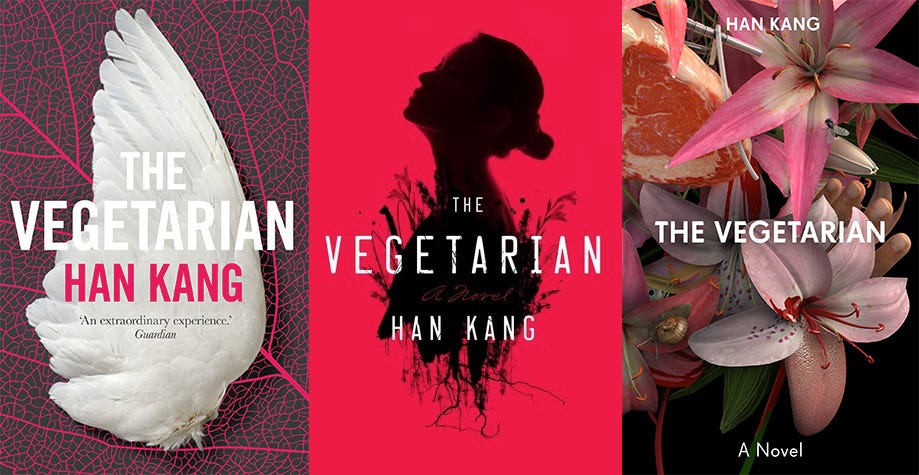
The novel traces the lives of two sisters in Seoul. In Hye, the elder, is a pragmatist—an entrepreneur running her own cosmetic store, married to a self-absorbed artist, and raising a three-year-old son. The younger sister, Yeong Hye, is a freelance graphic designer married to a man who describes himself as a “corporate slave.”
What is most striking initially is the sheer ordinariness of the premise. We see an unremarkable corporate employee married to a self-employed woman, both from ordinary families living ordinary lives. It is a portrait of a family defined by its commonality.
But the narrative fractures when Yeong Hye has a dream. It is a dream that compels her to turn vegetarian—an act of non-conformity that slowly transforms their domestic life into a living nightmare. What begins as a seemingly isolated incident spurred by a dream reveals a deeper, darker background that unfurls with haunting precision.

The story is told through three distinct voices, none of which belong to our protagonist. The first narration comes from her husband, Mr. Cheong, a man content to be married to a “disinterested” woman so long as she keeps his home running and provides adequate company in bed. Her strange habits do not disturb him until the day she stops storing meat in the house. This “behavioural kink” soon escalates into a series of disruptions that unravel his orderly life.
The second voice belongs to In Hye’s husband, a mediocre artist chasing an elusive masterpiece. His quest for “genius” becomes hopelessly entangled with his own sensuous and erotic desires. His fixation leads him into a troubling entanglement with Yeong Hye, who is by then descending into what the world labels mental instability.
The third voice is that of In Hye herself. As an elder daughter, wife, and mother in a South Korean family, she carries the collective burden and guilt of her household. Despite her success as a businesswoman, In Hye is tethered to her roles—until circumstances force a choice. Ultimately, she chooses to be a sister above all else.
Through these three lenses, the reader walks alongside Yeong Hye, witnessing her pain, her confusion, and her resolute, non-conformist silence. Han Kang’s writing is physically gut-wrenching, exploring themes of childhood trauma, the weight of a patriarchal society, and the boundaries of mental health. In under 200 pages, she avoids detailed ramblings, instead leaving a vast, evocative space for the reader to inhabit.

Mental Health Alert: The Vegetarian is an extremely disturbing read. I would suggest holding off if you are already feeling low or emotionally unsettled.
About the Contributor
Anupa is an educator and an avid reader who brings unique insight to her explorations of the written word. With an eclectic taste in books that ranges from the classic to the contemporary, she believes that literature serves as a vital mirror for our internal worlds. Through her contributions to ruminata, Anupa seeks to understand the architecture of hope and the complexities of the human condition.

Thanks for this review, Anupa. It's so thoughtful of you to add the mental health alert. I couldn't read the book when I first picked it up!